

There comes a point when it's not just a bad week anymore.
You don't feel like getting going in the morning. You're constantly on edge. You're not sleeping well. It's getting harder and harder to concentrate. You take on everything, and then you feel like it's all coming crashing down on you.
It is easy to treat these as separate problems.
Yet sometimes they refer to the same thing: Something hasn't been right for a while, and you can't change it on your own.
Our conversation with Dr. Eszter Fodor-Marosujvári, life and business coach and consultant in Ultra-Short Therapy In the third and final section, we looked at what signs might indicate that it might be worth seeking outside help.
Important: This is not a diagnostic checklist. It’s not the case that if you check off three items, you need a coach. According to Eszter, this is precisely why the initial consultation is so important—it may reveal that another professional, rather than a coach, is better suited to provide the help you need.
Let's take a look at the signs that are worth thinking about:
1. You don't even feel like getting started in the morning
We're not talking about just any bad Monday.
It's about when your motivation disappears for good. You don't really care about what you're doing, you're stuck in a rut, and every morning it gets harder and harder to bring yourself to start the day.
Esther cites this as one of the clearest signs:
„You wake up in the morning and don’t feel like doing anything. You don’t feel like getting going, you have no motivation, you’re fed up, and you’re bored with your life.”
It's natural to have a bad day. But if that becomes the norm, it's worth paying attention to.
2. Are you constantly stressed?
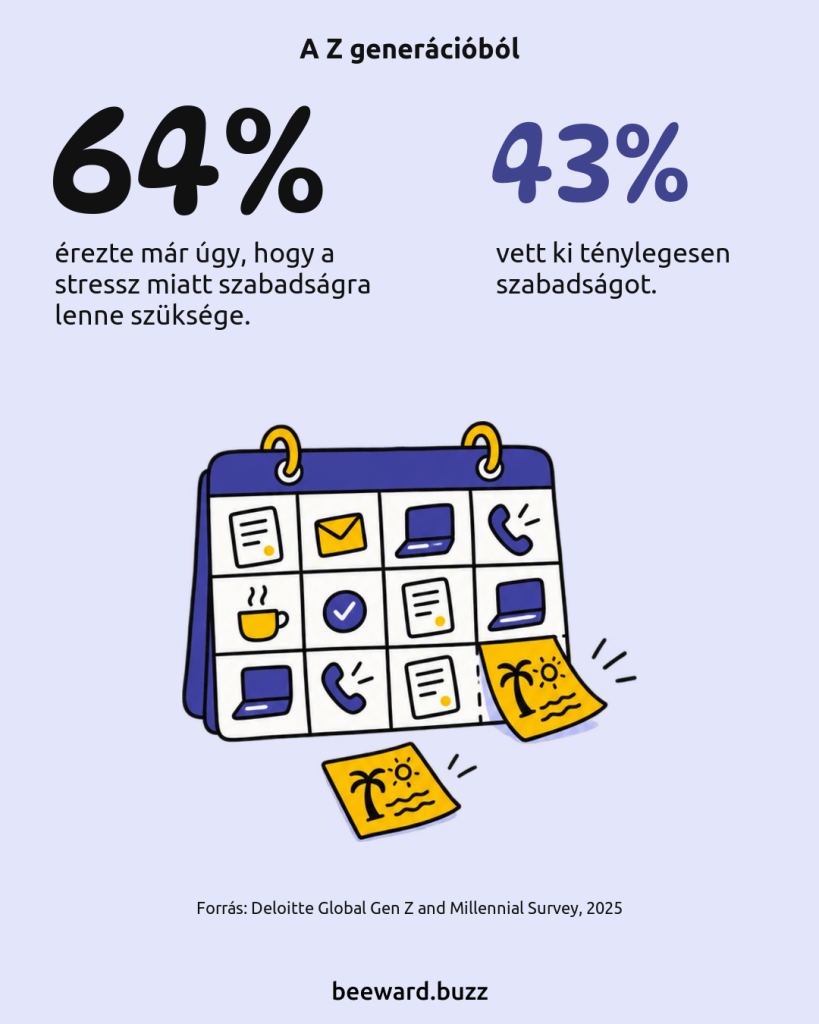
Your brain doesn't stop working even after work.
You keep working in your head, replaying conflicts, and thinking about the next day’s tasks. At night, you have trouble falling asleep, or you simply feel like you’re constantly on high alert.
Eszter is the constant tension, anxiety, restlessness, and difficulty sleeping He also mentions it as a sign that warrants further investigation into what lies behind it.
3. You can't concentrate
You sit down to work, but you're not making any progress.
You start one task, then dive into another, and then a third one pops into your head. By the end of the day, you’re exhausted, yet you feel like you’ve barely gotten anything done.
This isn't necessarily a time-management problem.
It may be that you're simply trying to keep too many things in mind at once, and you no longer have enough mental capacity to do so.
4. You feel like everything is falling apart around you
It's getting harder and harder to decide what's important and what can wait.
Everything seems urgent. Everyone wants something from you. And you try to meet everyone’s expectations. Meanwhile, you completely lose sight of your own life.
According to Eszter, it can be a warning sign when someone is no longer able to prioritize or manage their time, and feels that no matter what they do, tasks keep piling up in front of them—it’s like being on a never-ending hamster wheel.
5. You Can't Say No

This is a particularly insidious problem in the workplace.
People who say "yes" to everything are often assumed to be hard-working, reliable employees who can handle anything.
However, there is a limit to how much weight it can bear.
According to Eszter, someone who can handle everything thrown at them may seem like an exceptionally good employee at first glance. At the same time, however, they constantly overwork themselves, fail to set boundaries, and sooner or later simply burn out.
The inability to say “no,” therefore, is not necessarily a virtue, but in many cases a symptom of a problem that can come at a high cost.
6. Your body will also start to show signs
You'll get sick more often. You'll stay home more often. It'll become harder and harder for you to bring yourself to go to work.
It’s important to be particularly careful with how we phrase this: Frequent illnesses can, of course, have numerous physical causes, so they must be taken seriously from a medical standpoint as well.
But if, in addition to physical symptoms, you’re also experiencing chronic stress, exhaustion, a loss of motivation, or anxiety at work, it’s worth examining the role your life situation or your job plays in this. Eszter often hears from her clients that only illness can stop them—that their bodies can put up a “STOP” sign. But is it really worth waiting?
7. You end up back in the same place over and over again
This is perhaps the least noticeable sign.
You know what you should do differently. You know you should say no. You know you should make changes to a relationship, your job, or the way you function.
You'll give it a try.
Then, a few weeks or months later, you'll be right back where you started.
In her work, Eszter often encounters situations where someone understands their problem but is still unable to make lasting changes. In such cases, it’s not necessarily the case that what’s missing is yet another time-management technique or more good advice. Perhaps what’s needed is to understand that, Why does the same pattern keep repeating itself over and over again?. Without this, we can change our workplace, our partner, our circle of friends, and so on, but it’s highly likely that sooner or later the same situation will arise in a different guise.
You don't have to wait until the problem gets serious
One recurring theme in our conversation was that, for many of us, asking for help is difficult in and of itself.
Because we've learned that we have to solve our own problems.
Because we don't want others to see us as weak.
Or we simply think: Other people have much more serious problems than this.
We often go right up against the wall before we realize where we've ended up.
Eszter then said something that we think serves as a fitting conclusion to this three-part series:
„The bravest decision is to own up to our weaknesses.”
And he immediately added:
„Admitting it is what makes me so damn strong,
”that I have my own problems, too."
However, it’s also important to note that coaching isn’t the answer to every problem. You may need a coach, but it’s also possible that a psychologist is the better choice. You might need to see a doctor, or it might simply be enough to have a heart-to-heart talk with someone you trust. There are many options to choose from.
The key point—and the first important step—is not that we know exactly—or rather, that we don't know— Let’s recognize when something is consistently wrong, and let’s not wait until it completely overwhelms us. Let’s have the courage to face it, take action, and—if we feel it would be easier not to go through this alone—ask for support. That is true courage; that is where our true strength lies.
The expert quoted in the article
Dr. Eszter Fodor-Marosujvári is a life and business coach and a consultant in Ultra-Short Therapy. She worked as a lawyer for nearly twenty years before deciding to pursue coaching full-time. In recent years, she has worked with more than 120 clients in both the life and business fields. In her work, she combines coaching with the methods of Ultra-Short-Term Therapy, always tailored to the client's circumstances and goals.
Coaching services are also available as part of Beeward's core rewards.
If you'd like to learn more about his work or get in touch with him, you can find him on the following platforms:

More articles in this series
This article is part of a series of interviews in which, with Eszter’s help, we explore issues related to coaching, leadership, and workplace well-being.
✓ When Should You Turn to a Coach? A Coach Answers
✓ Why Doesn't Mandatory Coaching Work?
✓ 7 Signs It's Time to Ask for Help.
Are you a coach, trainer, mentor, or some other type of development professional?
If you believe that growth can be a reward in itself, get in touch with us. We’re constantly expanding our core rewards program to include professionals who help make workplaces better.


