

Have you ever had that feeling where you knew exactly what you should do, but you just couldn't bring yourself to do it?
You read the books, listened to the podcasts, and asked your friends for their opinions, yet weeks or even months later, you were still in the same place.
Often, in moments like these, it’s not new information we need. Rather, it’s someone who can help us see what’s going on inside us from a different perspective.
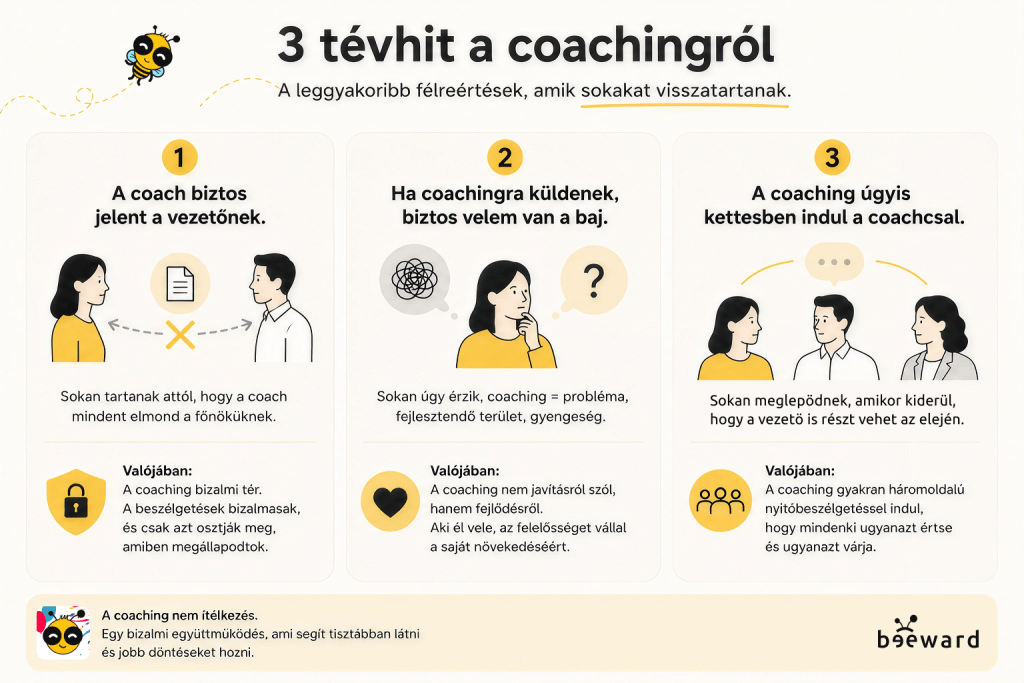
However, there are still many misconceptions about coaching. Many people think it’s only for managers, or that it’s worth turning to a coach only when we’re already struggling with serious problems.
We spoke with Dr. Eszter Fodor-Marosujvári, a life and business coach and consultant in Ultra-Short Therapy, about when it’s a good idea to seek help, and how to recognize that there might be more behind a setback than just a bad week or a temporary loss of motivation.
You don't have to wait until there's a big problem
Coaching isn’t primarily intended for crisis situations, nor is it about someone telling you what to do. Rather, it’s a confidential conversation where, in a safe environment, you can reflect on your own situation, recognize your patterns of behavior, and gain a clearer view of your options.
In fact, it is often not a lack of information.
We know exactly what we should do. But for some reason, we just don't do it.
„Our emotions guide us. It’s not always enough to know what we should do.”
In what kinds of situations can a coach help?
There is no single list that can definitively determine whether you need coaching. Every person is different, and every life situation is different.
And yet There are recurring patterns that often appear for those who ultimately turn to a coach.
1.) You keep running the same laps over and over again
Have you ever changed jobs, gotten a new boss, or found yourself in a completely different life situation, only to run into the same problems?
At times like this, it’s worth asking yourself: Is it really that the environment is repeating itself, or is there a pattern in your behavior that leads you to the same place over and over again?
In a coaching process, recognizing these patterns is often the first important step.
2.) You know what you should do, but you don't do it
This is perhaps one of the most common situations.
You know exactly what the next step should be, yet you keep putting it off. There’s always something more important to do, and at the end of the day, you’re right back where you were in the morning.
It’s easy to assume laziness or a lack of discipline in such situations, but often there’s something entirely different at play. It could be an old habit, a past failure, or an inner fear—one that’s much easier to recognize from an outsider’s perspective.
3.) You've been putting off an important decision for months
Change jobs?
Will you accept the new management position?
Should you finally talk to a coworker, or just keep putting up with it?
If you’ve been repeating the same arguments to yourself for months, perhaps what you need isn’t more advice, but someone to help you sort through your thoughts—someone who can ask a fresh question that breaks you out of your usual way of thinking.
4.) You're in a situation that's draining all your energy
It's not just problems at work that can cause setbacks.
A divorce, an illness, caring for a family member, financial difficulties, or a new life situation following the birth of a child can easily upset that balance.
At times like this, many people feel that they have become worse employees.
Yet they often simply have too much on their plates at once.
According to Eszter, during these times it can be especially important to have someone with whom you can talk about everything that’s happening without being judged. This is beneficial not only for the individual but also for the company, as it helps bring the employee back toward a state of balance. They can find relief, discover possible solutions, and receive support without burdening their manager or coworkers.
There's a question that doesn't have a simple answer
During our conversation, we wondered if there might be a questionnaire that could determine whether you need coaching.
Eszter's answer was surprisingly clear.
„I don't really believe in these surveys.”
There's a simple reason for this. Two people may come in with the same problem, yet they may need completely different kinds of help.
- It might be coaching.
- He might be a psychologist.
- It might be a different method.
This is precisely why the first, so-called “zero” session is considered important. The goal of this session is not to start coaching at all costs, but to determine together whether this is truly the right path. If not, a responsible professional will guide the client in a different direction. Uniqueness, individual perspectives, and the “chemistry” between the coach and the client can be more reliably assessed through a conversation.
Often, the problem itself isn't the biggest obstacle
But it's the first step.
According to Eszter, there are many people who show interest, send an initial message asking for an appointment, and then simply disappear.
Not because the problem has gone away. But because, in many cases, the ego speaks up in the meantime.
- What will they think of me?
- Shouldn't I be the one to figure this out on my own?
- What if I'm the only one who's like this?
And sometimes change itself seems frightening.
„It takes an incredible amount of inner work for someone to take that first step.”
Perhaps many people turn back at this very point.
Yet asking for help is not a sign of weakness; acknowledging our difficulties, facing our problems, and setting out on the path to change is a courageous process that requires a great deal of strength.
The most important insight
At the end of the conversation, Eszter said something that, in our opinion, perfectly sums up the essence of coaching.
„The bravest decision is to own up to our weaknesses. I become truly strong when I admit: I have problems, too.”
Perhaps that is why it is worth thinking about coaching in a different way.
People don't sit down with a coach because they're weak.
Rather, it is because they want to understand themselves better, see their situation more clearly, and make their next decision more consciously, so that they can shape a life whose defining characteristic is contentment.
The expert quoted in the article
Dr. Eszter Fodor-Marosujvári is a life and business coach and a consultant in Ultra-Short Therapy. She worked as a lawyer for nearly twenty years before deciding to pursue coaching full-time. In recent years, she has worked with more than 120 clients in both the life and business spheres. In her work, she combines coaching with the methods of Ultra-Short Therapy, always tailoring her approach to each client’s life situation and goals.
Coaching services are also available as part of Beeward's core benefits. If you'd like to learn more about his work or get in touch with him, you can find him on the following platforms:

More articles in this series
This article is part of a series of interviews in which, with Eszter’s help, we explore issues related to coaching, leadership, and workplace well-being.
✓ When should you turn to a coach? A coach answers.
✓ Why Doesn't Mandatory Coaching Work?
Upcoming episodes:
- 7 Signs It's Time to Ask for Help.
Are you a coach, trainer, mentor, or some other type of development professional?
If you believe that growth can be a reward in itself, get in touch with us. We’re constantly expanding our core rewards program to include professionals who help make workplaces better.