
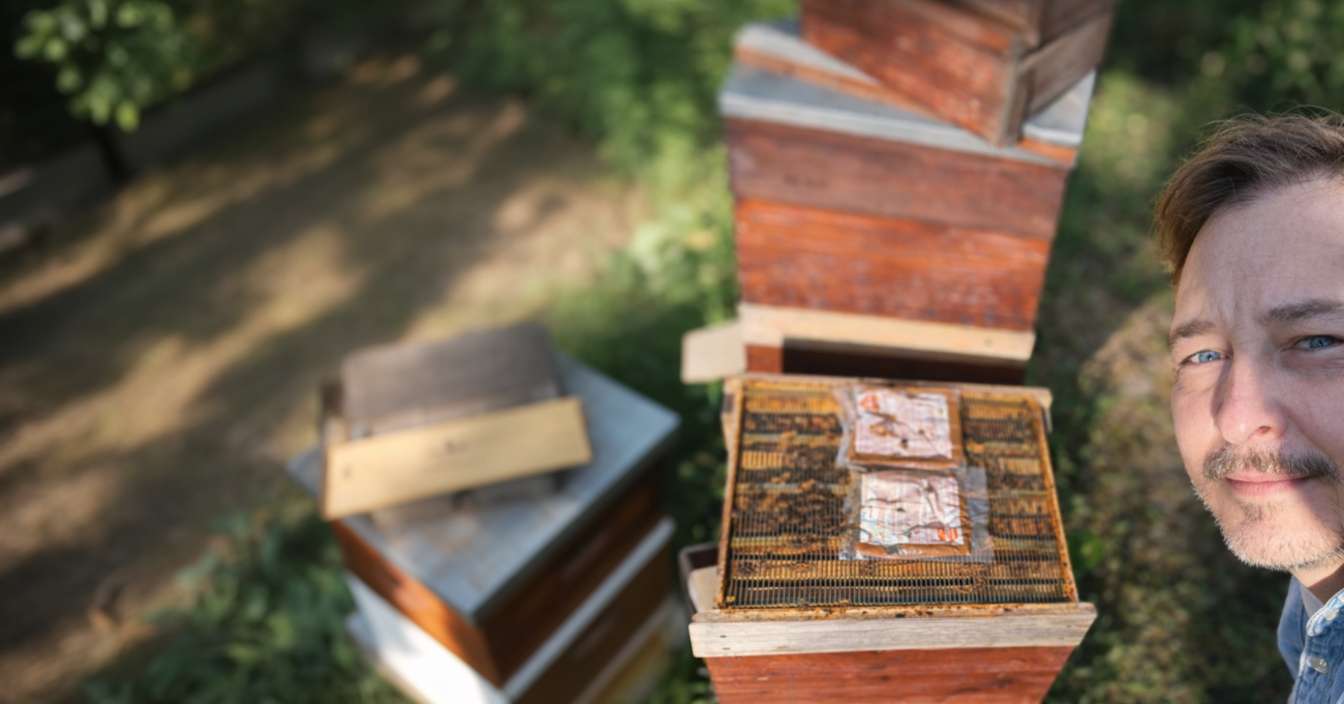
When we chose bees for the Beeward identity, it was a visual decision at first. A strong metaphor, a world to love. We knew that bees represented collaboration and community.
Then we started to go deeper. Not at the marketing level, but from the biological and behavioural side. And we came across more and more material that was specific shows parallels between the functioning of bee colonies and human organisms.
And what is really interesting is not that there are similarities, but how accurate they are.
The hive is a system, not a set of people
The bee colony is what science calls a superorganism. The unit of survival is not the individual but the system.
A worker bee lives for about 4-6 weeks in summer, then dies and the next one comes.
The hive is still open.
In contrast, most organisations rely heavily on key people. If someone drops out, there is an immediate problem. It's not a culture, it's a dependency.
The hive is strong because it survives individuals.
Appreciation is not kindness, it is information
Bees communicate by vibrating. A scout bee transmits precise information about where a good nectar source is, how far away and how valuable it is.
This is not enthusiasm.
This is data.
This is how the hive decides where to direct its resources. In most organisations, good work is not visible. It gets lost in a meeting or a message.
But recognition is not extra. Recognition is a signal that the system can work.
Culture does not collapse, it disappears
It is a well-known phenomenon in beekeeping that workers simply do not return to the hive. The system is physically there, yet it is not working.
The same happens in companies. Everything is „fine”, but people are no longer putting energy into it. They are not taking the initiative, they are not connecting.
Culture does not collapse loudly. It disappears quietly.
Talking to a beekeeper
On Easter Monday, I went to a neighbour's for coffee. Peter is a hobby beekeeper and has a few hives in the garden.
He said that most of the worker bees live for about 6 weeks in the summer, and then the next ones come. The system still remains stable.
He also told us that the hive constantly monitors its own condition and reacts immediately if something goes wrong.
And there was a surprising example: when food is scarce, the bees go to other hives to steal. At first they fight, but if they return several times, they take on the smell of the other hive and after a while they are accepted.
This is not kindness. It's accommodation.
The hive regulates itself
Bees are constantly regulating their environment. Temperature, activity, function.
Most organisations don't regulate, they just react when things are going wrong.
That's why there is overspinning, burn-out or even complete slowdown.
The hive is not overstretching itself. The hive seeks balance.
What does this mean in practice?
Bees cannot be copied. Humans don't work that way.
But their logic can be learned:
- good performance should be visible
- have clear signals
- not everything depends on one person
- have continuous feedback
- the system should be able to regulate itself
Why is this important at Beeward?
Beeward is not meant to be an HR tool, but an approach.
An attempt to make recognition not an extra, but a daily signalling system in the life of a team.
Because when good work is visible, the system is strengthened.
When the signal disappears, the energy disappears with it.
Maybe the hive is not just an architectural element.
It may be an operational pattern.
Resources and inspiration
- E.O. Wilson: The Superorganism
- Thomas D. Seeley: Honeybee Democracy
- Deborah Gordon's research (social insect behaviour)
- Camazine et al: Self-Organization in Biological Systems
- Bonabeau, Dorigo, Theraulaz: Swarm Intelligence
- Beekeeping observations (interview with a local beekeeper)


