

It's not because coaching doesn't work.
But because it's being offered in the wrong context and in the wrong way.
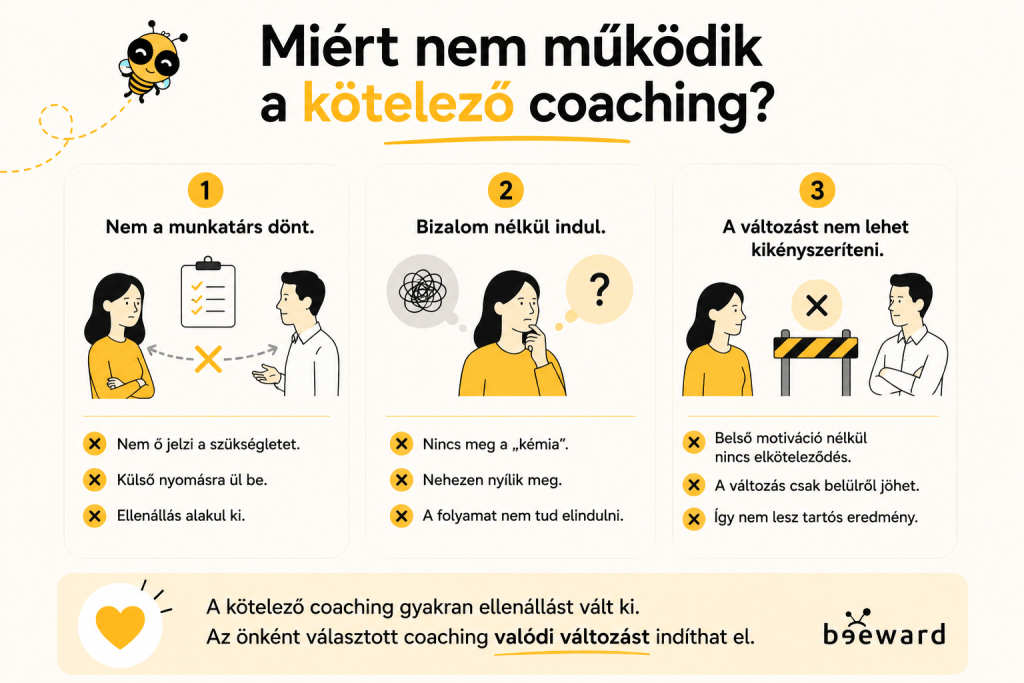
We talked about this again Dr. Eszter Fodor-Marosujvári a life and business coach and an Ultra-Short Therapy consultant, who believes that one of the most important factors determining the success of a coaching process is decided even before the first session.
Coaching isn't something you can force on someone
Many leaders say this out of good intentions:
„We'll send them to coaching.”
The colleague is tired. He’s having conflicts. His performance is declining. The manager wants to help.
However, coaching works even less like mandatory training.
„The fundamental measure of coaching effectiveness is,
”that the person sitting here wants change."
At first glance, it sounds obvious, but in practice, many organizations overlook precisely this point.
When an employee is sent to a coach, they can easily get the feeling that something is wrong with them. That they need to be fixed. That this is actually a subtly worded warning.
In such cases, resistance is a completely natural reaction.
Trust is more important than the method itself
Many people believe that a good coach can work with anyone.
Reality is much more human than that.
Coaching is not based on a technique or a set of questions, but on trust. If that’s missing, it’s harder to get the process started.
That is why Eszter introduced the the 0th time, the purpose of which is not to find solutions right away, but to determine whether they can work together at all.
We get to know each other. Is there chemistry? If so, then she can decide if she wants to come. If there isn't, everyone should be given the chance to say, "Thanks, but no thanks.".
Dr. Eszter Fodor-Marosujvári
Life and Business Coach, Ultra-Short-Term Therapy Consultant
feszekcoaching.hu

This freedom is not a minor detail. It is precisely this that creates the sense of security on which a sincere conversation can be built.
A leader doesn't have to solve every problem
Many leaders genuinely want to help.
He listens to his colleagues, offers advice, and tries to be there for them when someone is going through a difficult time.
That in itself is valuable.
The problem begins when a manager tries to help not only with professional issues but also with life situations for which they actually have neither the training nor the appropriate tools. A divorce, a sick family member, burnout, or a prolonged period of stress can all affect work, but dealing with these issues—beyond a certain point—is no longer a manager’s responsibility.
„It is not the manager’s job to solve every problem an employee has.”
That doesn't mean I'm insensitive. Quite the opposite.
A good leader recognizes when they can help and when a specialist is needed to support the employee with the appropriate tools.
Coaching doesn't always produce the results we expect
One of the most interesting parts of the conversation was when the topic of what happens when a company provides coaching to an employee came up.
Many people automatically assume that the purpose of the process is to help the employee perform better and stay with the company.
However, that's not always how it turns out.
It may turn out during these conversations that the employee is simply in the wrong position. At first glance, this might even seem like a failure.
In fact, however, this may be the most sincere and useful insight for both sides.
Coaching doesn't promise to make all problems disappear.
Rather, it helps you see things more clearly.
So how can corporate coaching work effectively?
Another approach also came up during the conversation.
What happens if it’s not the manager who selects a coach for the employee, but the employee decides on their own that they’d like to take advantage of this opportunity?
In this situation, the starting point is entirely different.
This is not a mandatory development program, nor is it a veiled warning.
Rather, it is an option that the person concerned decides on for themselves.
That is precisely why it can work well when coaching is presented as an optional reward. Not because it is free or easily accessible, but because the first step of the process is already It is not the manager's decision, but rather the colleague's.
And perhaps that is the difference that ultimately determines the success of coaching.
Change always starts from within
A coach isn't there to tell you how to live your life. They aren't there to solve problems for you. And they aren't there to „fix” people.
Rather, their role is to help clients see things more clearly, ask the right questions, and support the process that the client will ultimately have to go through on their own.
Maybe that's why mandatory coaching doesn't work.
Because real change doesn't start with an HR process; it doesn't come about through a manager's decision, but rather when someone says it themselves:
„I'd like to talk to someone.”
The expert quoted in the article
Dr. Eszter Fodor-Marosujvári is a life and business coach and a consultant in Ultra-Short Therapy. She worked as a lawyer for nearly twenty years before deciding to pursue coaching full-time. In recent years, she has worked with more than 120 clients in both the life and business fields. In her work, she combines coaching with the methods of Ultra-Short-Term Therapy, always tailored to the client's circumstances and goals.
Coaching services are also available as part of Beeward's core rewards.
If you'd like to learn more about his work or get in touch with him, you can find him on the following platforms:

More articles in this series
This article is part of a series of interviews in which, with Eszter’s help, we explore issues related to coaching, leadership, and workplace well-being.
✓ When Should You Turn to a Coach? A Coach Answers
✓ Why doesn't mandatory coaching work?
Upcoming episodes:
- 7 Signs It's Time to Ask for Help.
Are you a coach, trainer, mentor, or some other type of development professional?
If you believe that growth can be a reward in itself, get in touch with us. We’re constantly expanding our core rewards program to include professionals who help make workplaces better.